
Philippine higher education stands at a critical juncture. Fresh university graduates enter a challenging labor market shaped by inflation, stagnant entry-level pay, and rapid technological disruption. Rather than simply cutting General Education subjects, higher education must reframe GE into a work-focused, futuristic, and portfolio-driven framework that provides young Filipinos with economic direction, tech literacy, and career pathway.
Table of Contents
- The Economic Backdrop: Inflation, Wages, and Underemployment Pressure
- Transferable Skills vs. Market Realities: The Skill-Market Gap
- CHED’s 3rd GE Framing (RGECC) and the 2028 Pilot Delay
- The Case for Reframing: Elevating GE Instead of Cutting It
- A Comparative Blueprint: Senior High Redundancy vs. Futuristic GE
- Empowering Graduates as Strategic Decision-Makers for 2030
1. The Economic Backdrop: Inflation, Wages, and Underemployment Pressure
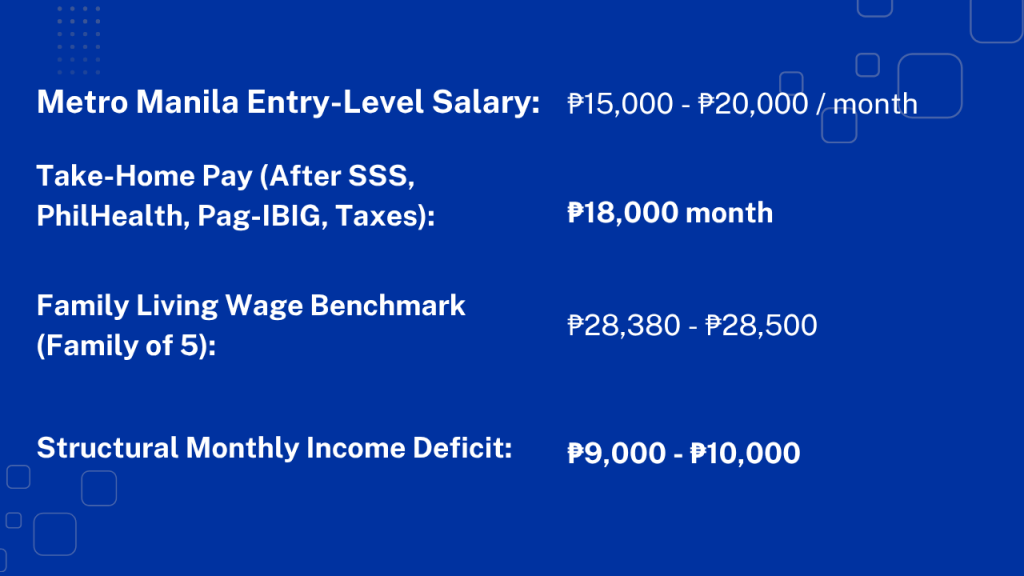
For decades, an entry-level monthly salary of ₱15,000 to ₱20,000 was considered standard for fresh college graduates in Metro Manila and urban centers. Today, that income level falls short of basic household survival.
- Philippine Statistics Authority (PSA) data shows headline inflation reaching 6.1% to 6.8%, driven primarily by volatile food, energy, and transportation costs.
- According to economic research by the IBON Foundation, a family of five in Metro Manila requires approximately ₱1,216 to ₱1,305 daily (roughly ₱28,380 to ₱28,500 monthly) to afford basic nutrition, housing, healthcare, and utilities. An entry-level salary of ₱20,000 leaves a structural monthly deficit of nearly ₱10,000 for single-income providers. PSA Labor Force Surveys indicate that while headline unemployment floats around 4% to 5%, the underemployment rate consistently ranges between 11% and 13%—representing over 5.5 million Filipinos who are employed but actively seeking additional hours or higher-paying jobs to match rising costs.
2. Transferable Skills vs. Market Realities: The Skill-Market Gap
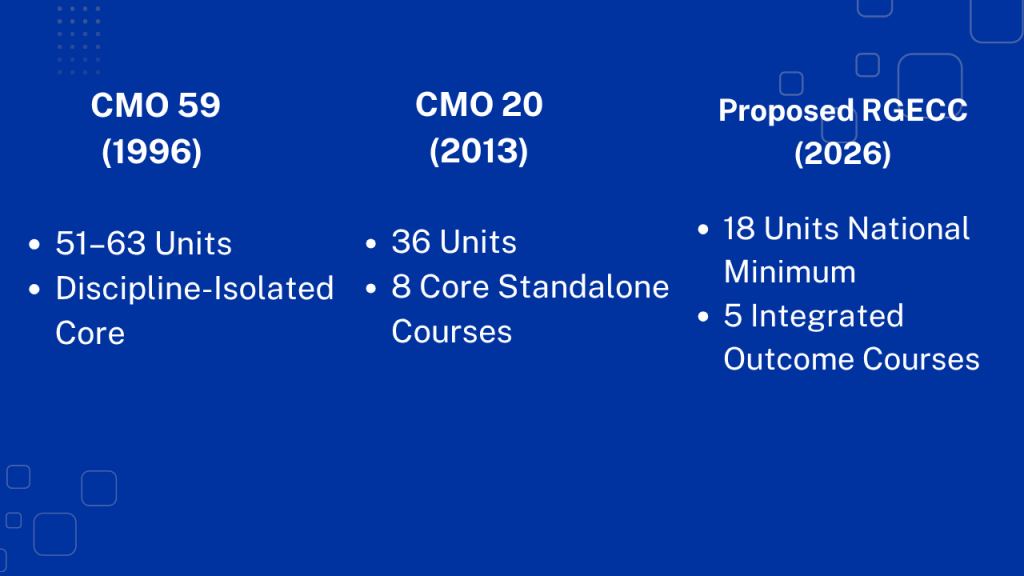
Under Commission on Higher Education (CHED) Memorandum Order No. 20 (s. 2013), General Education was streamlined to 36 units to cultivate broad, interdisciplinary “soft skills”—critical thinking, purposive communication, and global awareness. However, how well do these skills match labor market realities?
The Skill Disconnect and Employer Needs
- Employer Skill Shortages: A landmark World Bank study, “Developing Socioemotional Skills for the Philippines’ Labor Market,” revealed that 66% of Philippine employers (two out of three) experience difficulty filling job vacancies due to a lack of critical socioemotional and soft skills—specifically problem-solving, adaptive communication, and execution discipline.
- Global Educational Benchmarks: Programme for International Student Assessment (PISA) benchmarks show the Philippines scoring an aggregate 1,058 in overall student performance (Math: 355, Reading: 347, Science: 356). This trails regional ASEAN peers such as Singapore (1,679), Vietnam (1,403), Malaysia (1,213), and Thailand (1,182), demonstrating foundational learning gaps that higher education must rehabilitate.
The Shift to the Global Freelance Market
To escape low local entry wages, young workers increasingly turn to remote Virtual Assistance (VA), digital marketing, and software freelancing:
| Metric | Local Corporate Entry-Level | Global Remote / Digital Freelancing |
|---|---|---|
| Monthly Income Potential | ₱15,000 – ₱20,000 | ₱45,000 – ₱120,000+ ($5–$15+/hr) |
| Hiring Qualification | Academic Diploma & Transcript | Verifiable Portfolio, Work Samples, & Demos |
| Primary Skill Requirement | Generic Discipline Knowledge | Tool Fluency, AI Prompting, & Workflow Execution |
While remote freelancing offers higher pay, it presents a steep barrier: the portfolio trap. Studies from the Philippine Institute for Development Studies (PIDS) show that fresh graduates struggle because employers—both local and foreign—increasingly require verified project portfolios rather than traditional diplomas.
3. CHED’s 3rd GE Framing (RGECC) and the 2028 Pilot Delay
To address curricular redundancy and align higher education with global standards, CHED drafted the Reframed General Education Curriculum Component (RGECC)—marking the third major overhaul of collegiate GE, following CMO 59 (1996) and CMO 20 (2013).
The Proposed 18-Unit Structure
The proposed framework trims required GE units from 36 down to 18 national minimum units, featuring core subjects such as:
- Professional Communication
- Global Trends and Emerging Technologies
- Data, Evidence, and Ethics in a Knowledge Society
- Rizal and Philippine Studies
- Labor Education
The Great GE Controversy and Academic Resistance
The proposed overhaul triggered intense opposition from major universities (including the University of Santo Tomas, Ateneo de Manila University, University of the Philippines, and Philippine Normal University), academic unions, and faculty associations:
- Educators argue that CHED’s prescription of exact course titles, standardized syllabi, and outcome structures oversteps its mandate to set minimum standards, violating institutional academic freedom protected under Article XIV, Section 5.2 of the 1987 Philippine Constitution.
- Critics, such as former UST Philosophy Chair Prof. Paolo Bolaños, contend that stripping away dedicated philosophy, humanities, and art appreciation courses reduces higher education to a market-driven trade school designed solely to serve foreign corporate demands.
- Halving GE units threatens thousands of humanities and social science educators across public and private higher education institutions (HEIs) with job loss or reduced workloads.
- The reform assumes SHS graduates have already mastered humanities, ethics, and basic research. However, findings from EDCOM 2 (Second Congressional Commission on Education) highlight significant SHS learning losses, meaning tertiary students still require foundational reinforcement.
The Pilot Testing Delay
In response to widespread stakeholder pushback, position papers, and public discussions, CHED Chairperson Shirley Agrupis announced the postponement of the reframed GE pilot testing to 2028. CHED has formed an inter-agency Technical Working Group (TWG) to review stakeholder inputs and address curriculum redundancies without compromising educational quality.
4. The Case for Reframing: Elevating GE Instead of Cutting It
Simply cutting GE units to 18 risks turning higher education into narrow vocational training. The solution lies not in eliminating subjects, but in elevating and reframing them into work-focused, futuristic learning experiences.
Instead of repeating basic high school drills, tertiary GE should build economic literacy, AI fluency, and strategic career navigation—giving graduates the tools to make informed life and career choices based on data.
5. A Comparative Blueprint: Senior High Redundancy vs. Futuristic GE
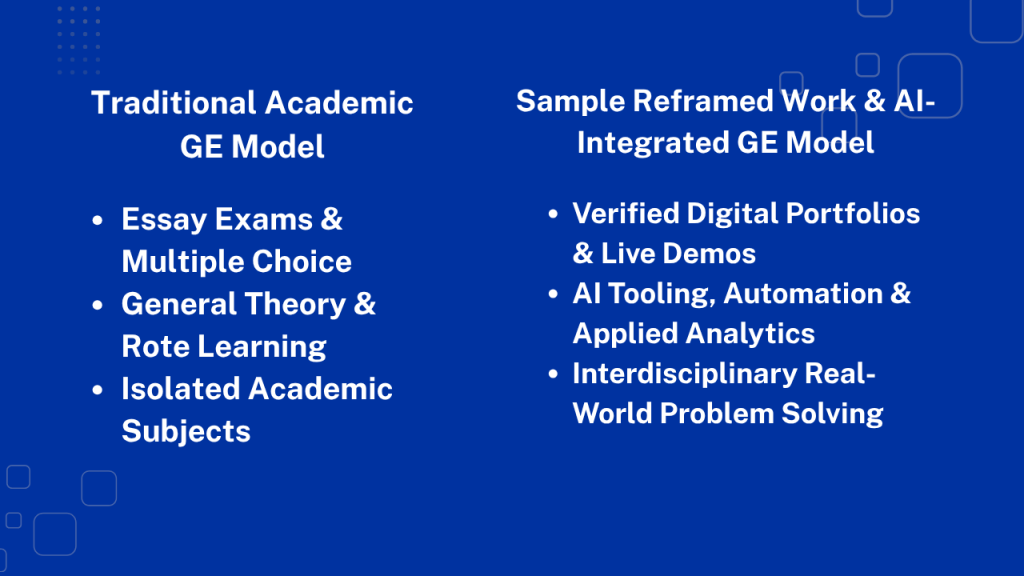
To eliminate content overlaps between Senior High School (SHS) and college, tertiary General Education must shift toward high-value, practical outputs.
| Traditional / SHS Redundant Course | Proposed Futuristic GE Course | Key Work-Focused Competencies Developed | Verifiable Student Deliverable / Portfolio Artifact |
|---|---|---|---|
| Purposive Communication (Essays and speeches) | Professional & Client Communication | Technical spec writing, B2B cold outreach, client negotiation, and AI-assisted copywriting | A public Client Pitch Deck, Freelance Proposal, or Corporate Communication Suite |
| Mathematics in the Modern World (Stats and formulas) | Data Analytics & Financial Intelligence | Financial modeling, inflation impact assessment, market trend analysis, and data visualization | A dynamic Business Analytics Dashboard or Personal Financial Strategy Model |
| Science, Technology, and Society (General science history) | AI Automation & Emerging Tech Ethics | Prompt engineering, workflow automation, low-code development, and ethical AI auditing | An automated AI Workflow Integration or Tech Impact Audit Report |
| Understanding the Self (Self philosopy/psychology intro) | Career Strategy & Personal Branding | Labor market analysis, personal positioning, remote-work readiness, and portfolio architecture | A live GitHub/Behance Portfolio, LinkedIn Strategy, and Professional Digital Resume |
| Art Appreciation (Static art history) | UI/UX Design & Visual Communication | Visual branding, user interface design, visual storytelling, and digital content creation | A complete UI/UX App Prototype or Brand Identity Media Kit |
6. The Philippine Opportunity: From “Graduate-Ready” to “Work-Ready”
The Philippines has already reduced the number of college GE units from the pre-K to 12 framework.
The next question should therefore be less about simply reducing or increasing the number of GE subjects.
It should be about what students can actually do after completing them.
The evidence points toward a potential direction:
- Keep the foundations.
- Reduce unnecessary duplication.
- Increase practical application.
- Strengthen digital and AI literacy.
- Connect education with industry.
- Build portfolios.
- Expand experiential learning.
- Update curricula more frequently.
For example, professional communication is a transferable skill that can be strengthened through recognized English proficiency assessments. CEFR-aligned proficiency levels and TOEIC assessments could serve as optional ways for students to demonstrate their English-language abilities, complementing GE coursework and portfolio projects. Education and training providers such as Hopkins.ph could be explored as potential partners for language-learning and assessment pathways, subject to verification of their specific offerings and certification arrangements.
This is especially important because EDCOM II reported that CHED’s review and updating of bachelor’s-degree Policies, Standards and Guidelines has historically taken an average of about 11 years, raising concerns about keeping curricula aligned with rapidly changing workforce and technological needs.
A curriculum that takes more than a decade to substantially update can struggle to respond to technologies that may transform within only a few years.
7. Empowering Graduates as Strategic Decision-Makers for 2030
General Education in the Philippines’ Future
General Education should not become a collection of employment-training subjects.
- History still matters.
- Ethics still matters.
- Art still matters.
- Communication still matters.
- Mathematics still matters.
- Science and technology still matter.
- Understanding society still matters.
But their value can become greater when students are taught how to apply these forms of knowledge to real problems.
The future of Filipino education may therefore require a shift from:
“What subjects should students complete?”
to:
“What should Filipino graduates be able to understand, create, solve, communicate and demonstrate by the time they enter the workforce?”
A reframed General Education curriculum could answer that question by combining human knowledge, professional skills, digital literacy, AI awareness, entrepreneurship and practical experience.
The ultimate goal should not be to produce graduates who are trained only for today’s jobs.
It should be to produce Filipinos who are capable of learning, adapting and creating value in the jobs of tomorrow.
By 2030, the most valuable graduate may not simply be the one with the longest list of completed subjects.
It may be the graduate who can say:
“Here is what I learned. Here is what I can do. Here is what I created. Here is how I solved a problem. And here is how I can continue learning when the world of work changes.”
References:
laferenal. (2026). Princeton assessments and Training, Inc. TOEIC, TOEFL – Princeton Assessments and Training INC.
https://www.hopkins.ph/about/princeton
CHED K to 12 Transition Program | Commission on Higher Education. (2017, September 5). Commission on Higher Education.
https://legacy.ched.gov.ph/k-12-project-management-unit/
EDCOM 2 Communications. (2025, May 28). PH college courses: heavy on general education, lacking in practical training – EDCOM 2. Edcom 2.
Largoza, G., & Fernandez, C. G. (2025). Review of CHED Policies, Standards, and Guidelines (PSGs) Pre- and Post-K to 12 Reforms.
https://doi.org/10.62986/dp2025.13
Mapa, C. D. (2025). Philippine Statistics Authority | Republic of the Philippines. Psa.Gov.Ph.
https://psa.gov.ph/price-indices/cpi-ir
Philippine Statistics Authority. (2023, July 10). Family Income and Expenditure Survey | Philippine Statistics Authority | Republic of the Philippines. Psa.Gov.Ph.
https://psa.gov.ph/statistics/income-expenditure/fies
Labor Force Survey | Philippine Statistics Authority | Republic of the Philippines. (n.d.). Psa.Gov.Ph. Retrieved October 5, 2026, from
https://psa.gov.ph/statistics/labor-force-survey/latest-press-release
Philippine Statistics Authority. (2023, September 22). Occupational Wages Survey | Philippine Statistics Authority | Republic of the Philippines. Psa.Gov.Ph.