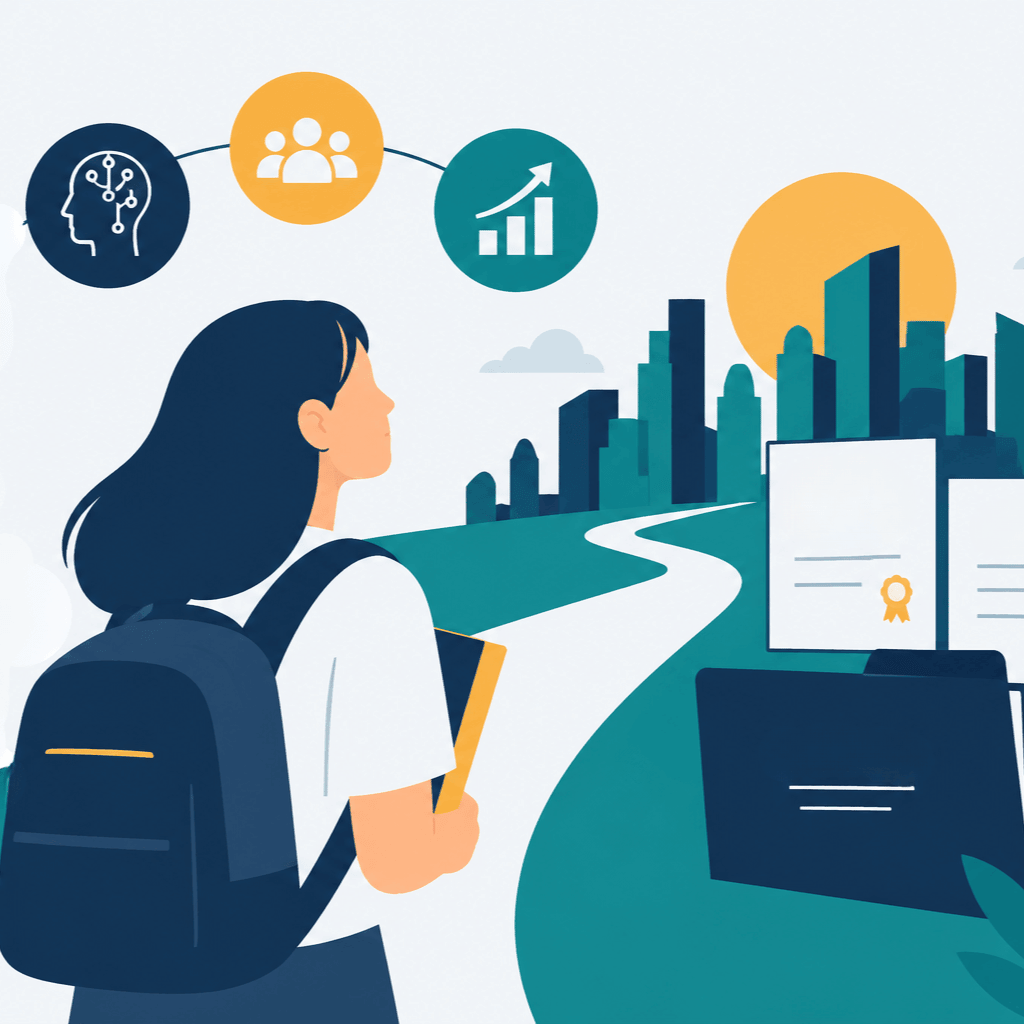
Imagine your child getting a high score in Mathematics but struggling to calculate a simple shopping discount. They may have memorized the formula, but can they apply it in real life?
This is the challenge the MATATAG Curriculum aims to address by prioritizing essential competencies and making learning less congested. With Grade 10 scheduled for implementation in School Year 2027–2028, parents should understand what this transition means for their children’s education.
Less Memorization, More Practical Learning
The MATATAG Curriculum emphasizes foundational knowledge and essential skills. In Mathematics, this could mean applying percentages to household budgets or shopping discounts. In Science, students might investigate how pollution affects their local environment rather than simply memorizing definitions.
These examples illustrate meaningful learning, although actual classroom activities depend on the teacher and applicable curriculum guide.
Reducing competencies is a positive step, but the real measure of success is whether students can apply what they learn—not simply finish their lessons.
Preparing for Grade 10 and Beyond
For parents, the MATATAG Curriculum is more than a change in school requirements—it is a reminder to look beyond grades and ask whether their children are truly learning. As Grade 10 joins the rollout in SY 2027–2028, stay involved, talk to your child’s teachers, and help your child explore the Senior High School path that fits their strengths and interests. Ultimately, your child’s success is not measured by grades alone, but by how well they can use what they learn to face real-life challenges and make informed decisions about their future.
Improving the curriculum may help students learn more effectively, but what about other challenges, such as reading comprehension, overcrowded classrooms, and unequal access to learning resources? . It raises a bigger question about the future of Philippine education. If these problems require different solutions, can one broad reform truly address them all?
Perhaps the real question is not simply whether the MATATAG Curriculum will work, but whether we fully understand the problems we are trying to solve. Before we ask how to fix Philippine education, shouldn’t we first ask what, exactly, needs fixing—and where should we begin?
When a typhoon, flood, earthquake, extreme heat, poor air quality, or another emergency disrupts school operations, parents often face the same difficult question: Is school actually suspended, or is my child still expected to study from home?
The answer is increasingly dependent on local conditions and the school’s Learning and Service Continuity Plan (LSCP).
The Department of Education (DepEd) has established a framework that prioritizes the safety of learners and school personnel while also protecting learning continuity. Under the current rules, the suspension of face-to-face classes does not necessarily mean that learning activities stop altogether. When conditions and resources allow, schools may shift to Alternative Delivery Modes (ADMs), including modular, online, or blended learning.
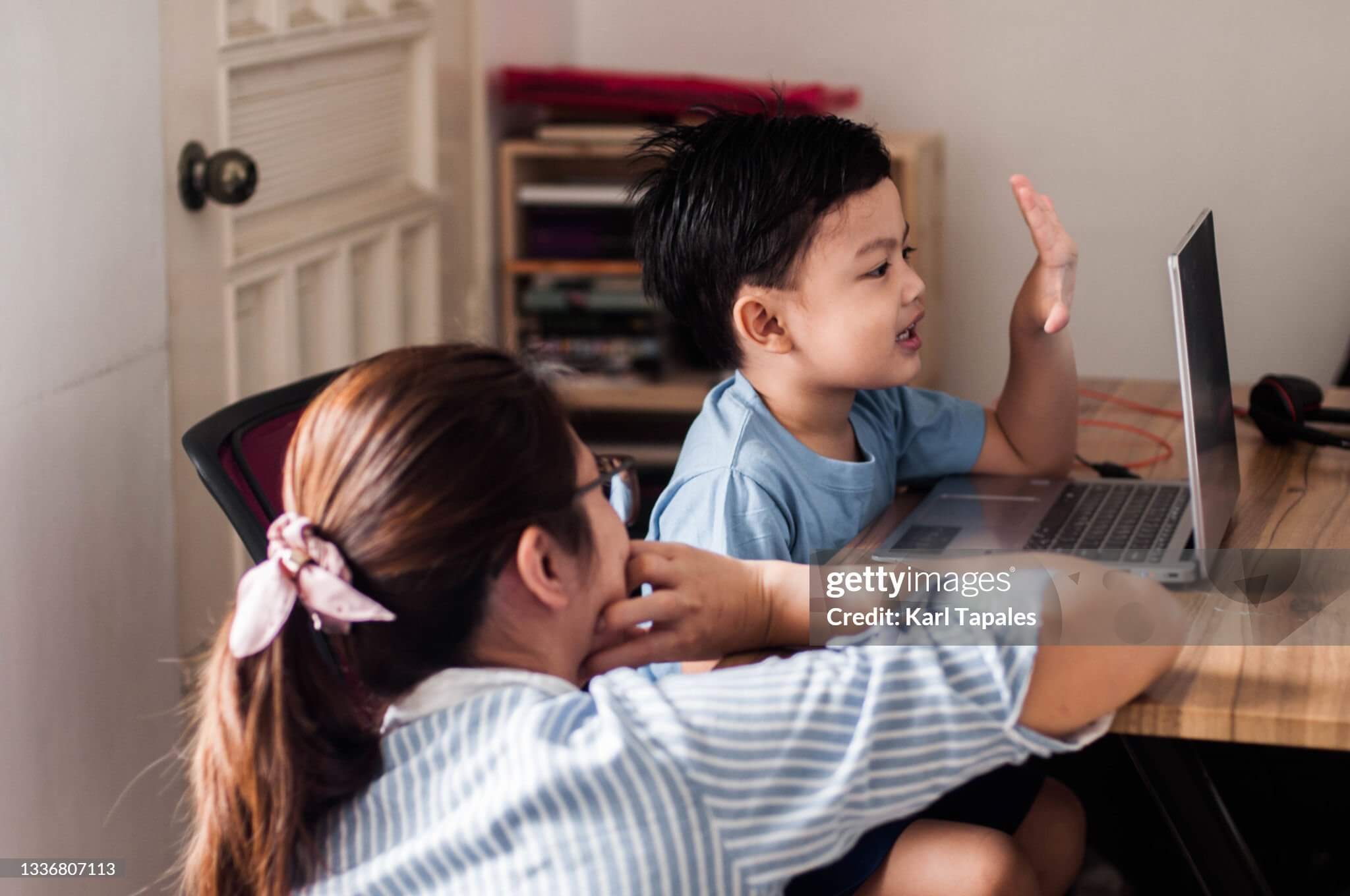
For working parents, however, this creates a second challenge: how do families manage an unexpected school schedule while maintaining work, childcare, internet access, printed modules, and school requirements?
What happens when classes are suspended?
DepEd Order No. 022, s. 2024, provides the current revised guidelines on class and work suspensions during disasters and emergencies. The policy covers hazards such as typhoons and tropical cyclones, heavy rainfall and flooding, earthquakes, power interruptions, extreme heat, poor air quality, and other emergencies.
The objective is twofold:
Protect learners and school personnel from unsafe conditions.
Prevent unnecessary interruption of learning.
This means parents should distinguish between suspension of face-to-face classes and a complete suspension of learning activities.
When appropriate, schools may move to distance-learning arrangements such as:
Modular Distance Learning (MDL)
Online Distance Learning (ODL)
Blended learning
Other appropriate Alternative Delivery Modes
The specific approach can depend on the local situation, available resources, and the school’s continuity plan. DepEd has emphasized that localized assessment is important because hazards and their effects can differ significantly from one community to another.
Why the decision can differ from one area to another
A typhoon affecting one municipality does not necessarily create the same conditions in another.
One community may experience flooding, while another may remain relatively accessible. One school may have electricity and internet connectivity, while another may be dealing with power interruptions or damaged facilities.
For this reason, the current framework gives local authorities and school heads responsibilities in assessing conditions and implementing appropriate responses.
A 2026 Schools Division memorandum in Catanduanes, for example, reiterated that school heads may select appropriate ADMs when face-to-face classes are suspended because of calamities and emergencies, where circumstances and resources permit. It also provided for consideration for learners who cannot complete activities because of the disruption.
For parents, this means that a national announcement about a hazard does not always translate into exactly the same learning arrangement for every school. Parents should follow the official announcement from their local government, Schools Division Office, and school.
This is one of the most important distinctions for parents.
A shift from classroom instruction to learning at home does not automatically mean that the school year has been shortened.
The legal framework for the school calendar allows class days to include learning activities conducted outside the traditional classroom. The implementing rules of Republic Act No. 7797, as amended by RA 11480, define class days as days when curricular and co-curricular activities are conducted within or outside school premises, including the home, to achieve learning objectives. The rules also provide for a school calendar of up to 220 class days.
This helps explain why schools can use ADMs to maintain instructional continuity during emergencies rather than simply adding a long series of missed days to the end of the school year.
If distance learning is feasible, a learner may still be expected to complete assigned activities, attend online sessions, submit outputs, or work through modules even when there is no face-to-face meeting.
If online or modular learning is not feasible, make-up arrangements may instead be considered. The 2026 Catanduanes guidance, for example, states that make-up classes may be conducted when online or modular learning cannot be implemented, with scheduling coordinated with teachers and parents or guardians.
K–12 is not being abolished because of these changes
Parents should also be careful about social-media posts claiming that the K–12 system is being abolished whenever DepEd announces a curriculum change, new track structure, or different learning arrangement.
RA 10533, the Enhanced Basic Education Act of 2013, remains the legal foundation for the country’s enhanced basic education system. The law established the enhanced basic education program and provides the framework for curriculum development, including the authority of DepEd to develop and refine the basic education curriculum.
What can change are the curriculum, subjects, tracks, learning standards, implementation timelines, and delivery arrangements.
This distinction is particularly important as DepEd continues to implement curriculum reforms, including changes involving Senior High School.
A curriculum restructuring should therefore not automatically be described as the abolition of K–12. Parents should look for an official DepEd order or memorandum before accepting claims circulating online.
A normal school day may suddenly become a home-learning day requiring:
A parent or guardian to supervise activities
A device for online classes
Reliable internet connectivity
Printed modules or learning materials
A quiet area for studying
Monitoring of deadlines and submissions
Communication with teachers
Assistance with activities that the learner cannot complete independently
Not every household has these resources available at the same time.
This is why parents should not assume that an online class announcement is the only possible arrangement. DepEd’s framework recognizes different delivery modalities, including modular and blended approaches, depending on circumstances and resources.
A practical checklist for parents
When your child’s school announces an ADM shift, ask these questions:
1. Is the announcement a suspension of face-to-face classes or a complete suspension of learning activities?
These are not necessarily the same.
2. What ADM will be used?
Find out whether your child will use printed modules, online activities, asynchronous work, synchronous classes, or a combination.
3. What are the submission deadlines?
A parent working from home or outside the house may need to reorganize childcare and work schedules around these requirements.
4. What happens if there is no electricity or internet?
Ask the school what alternative arrangement is available if the household cannot access online activities because of the disaster.
5. Will missed activities affect attendance or grades?
Keep copies or screenshots of school announcements and communicate promptly with the teacher if the learner cannot complete work because of the emergency.
6. Is a make-up class required?
If ADM cannot reasonably be implemented, the school may need another approach to recover missed learning.
Public and private schools may not have identical procedures
DepEd’s disaster and emergency guidelines directly apply to public schools and DepEd-operated Community Learning Centers. Private schools and private ALS providers may opt to adopt the guidelines.
This is important for parents comparing the experiences of children in different schools.
A public school in one city may implement a particular ADM arrangement, while a private school may follow its own approved learning-continuity procedures.
Parents should therefore prioritize communications from their child’s own school instead of relying on screenshots or announcements from another school or municipality.
The bigger picture: flexibility without losing accountability
Climate-related disruptions are becoming an important consideration for school scheduling because a single nationwide response may not address the different conditions experienced by every community.
The current DepEd framework attempts to balance two priorities: keeping learners safe and keeping them connected to learning.
That is why class suspension and learning continuity should not be treated as contradictory concepts.
A school can suspend face-to-face classes while continuing education through an ADM. At the same time, the system provides mechanisms for make-up learning when alternative delivery is not feasible.
For parents, the most useful approach is to separate three questions:
Is it safe to go to school?
Can learning continue safely from home?
Are there administrative deadlines that remain in effect despite the disruption?
Understanding the difference can help families respond more calmly when a sudden announcement changes the school schedule.
Most importantly, parents should verify claims about K–12, class suspensions, curriculum reforms, and vouchers through official DepEd issuances rather than relying on social-media rumors. The education system can change its curriculum and delivery methods without meaning that the legal foundation of basic education has simply disappeared.
IRR of REPUBLIC ACT NO. 7797 – IMPLEMENTING RULES AND REGULATIONS OF REPUBLIC ACT NO. 7797, OTHERWISE KNOWN AS “AN ACT TO LENGTHEN THE SCHOOL CALENDAR FROM TWO HUNDRED (200) DAYS TO NOT MORE THAN TWO HUNDRED TWENTY (220) CLASS DAYS, AS AMENDED BY REPUBLIC ACT NO. 11480 – Supreme Court E-Library. (2024). Judiciary.Gov.Ph. https://elibrary.judiciary.gov.ph/thebookshelf/showdocs/2/100875
Philippine higher education stands at a critical juncture. Fresh university graduates enter a challenging labor market shaped by inflation, stagnant entry-level pay, and rapid technological disruption. Rather than simply cutting General Education subjects, higher education must reframe GE into a work-focused, futuristic, and portfolio-driven framework that provides young Filipinos with economic direction, tech literacy, and career pathway.
1. The Economic Backdrop: Inflation, Wages, and Underemployment Pressure
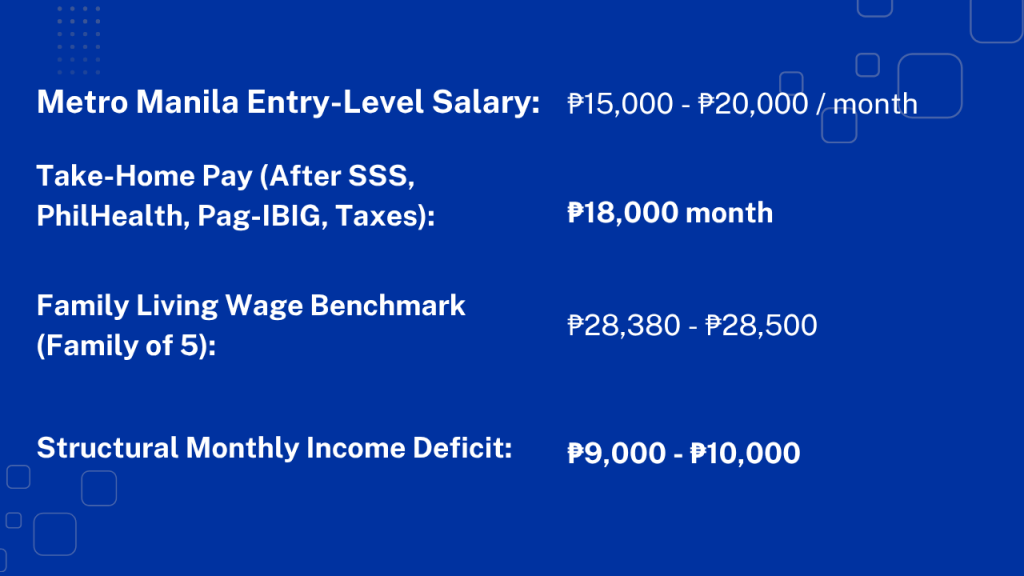
For decades, an entry-level monthly salary of ₱15,000 to ₱20,000 was considered standard for fresh college graduates in Metro Manila and urban centers. Today, that income level falls short of basic household survival.
Philippine Statistics Authority (PSA) data shows headline inflation reaching 6.1% to 6.8%, driven primarily by volatile food, energy, and transportation costs.
According to economic research by the IBON Foundation, a family of five in Metro Manila requires approximately ₱1,216 to ₱1,305 daily (roughly ₱28,380 to ₱28,500 monthly) to afford basic nutrition, housing, healthcare, and utilities. An entry-level salary of ₱20,000 leaves a structural monthly deficit of nearly ₱10,000 for single-income providers. PSA Labor Force Surveys indicate that while headline unemployment floats around 4% to 5%, the underemployment rate consistently ranges between 11% and 13%—representing over 5.5 million Filipinos who are employed but actively seeking additional hours or higher-paying jobs to match rising costs.
2. Transferable Skills vs. Market Realities: The Skill-Market Gap
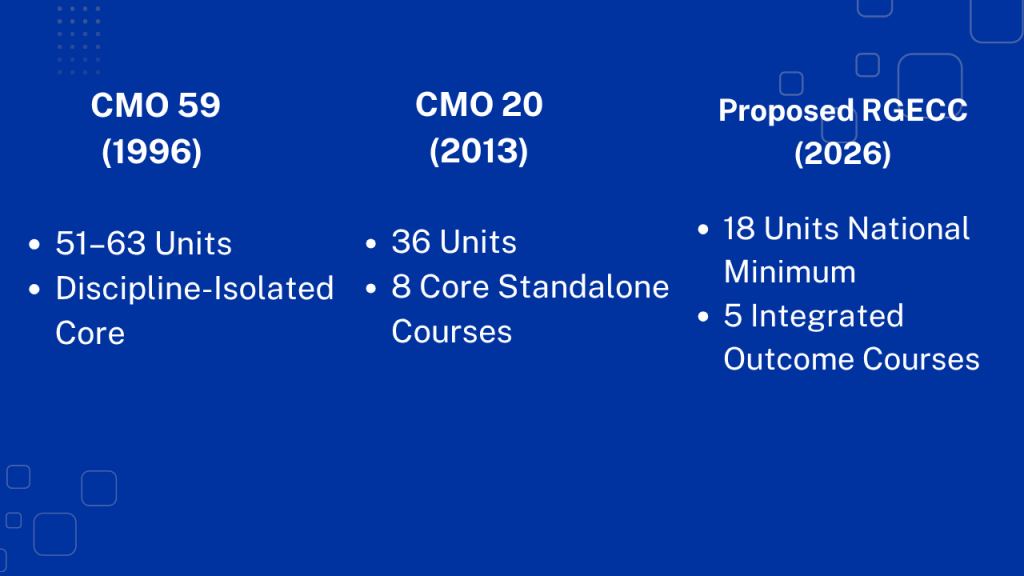
Under Commission on Higher Education (CHED) Memorandum Order No. 20 (s. 2013), General Education was streamlined to 36 units to cultivate broad, interdisciplinary “soft skills”—critical thinking, purposive communication, and global awareness. However, how well do these skills match labor market realities?
The Skill Disconnect and Employer Needs
Employer Skill Shortages: A landmark World Bank study, “Developing Socioemotional Skills for the Philippines’ Labor Market,” revealed that 66% of Philippine employers (two out of three) experience difficulty filling job vacancies due to a lack of critical socioemotional and soft skills—specifically problem-solving, adaptive communication, and execution discipline.
Global Educational Benchmarks: Programme for International Student Assessment (PISA) benchmarks show the Philippines scoring an aggregate 1,058 in overall student performance (Math: 355, Reading: 347, Science: 356). This trails regional ASEAN peers such as Singapore (1,679), Vietnam (1,403), Malaysia (1,213), and Thailand (1,182), demonstrating foundational learning gaps that higher education must rehabilitate.
The Shift to the Global Freelance Market
To escape low local entry wages, young workers increasingly turn to remote Virtual Assistance (VA), digital marketing, and software freelancing:
Metric
Local Corporate Entry-Level
Global Remote / Digital Freelancing
Monthly Income Potential
₱15,000 – ₱20,000
₱45,000 – ₱120,000+ ($5–$15+/hr)
Hiring Qualification
Academic Diploma & Transcript
Verifiable Portfolio, Work Samples, & Demos
Primary Skill Requirement
Generic Discipline Knowledge
Tool Fluency, AI Prompting, & Workflow Execution
While remote freelancing offers higher pay, it presents a steep barrier: the portfolio trap. Studies from the Philippine Institute for Development Studies (PIDS) show that fresh graduates struggle because employers—both local and foreign—increasingly require verified project portfolios rather than traditional diplomas.
3. CHED’s 3rd GE Framing (RGECC) and the 2028 Pilot Delay
To address curricular redundancy and align higher education with global standards, CHED drafted the Reframed General Education Curriculum Component (RGECC)—marking the third major overhaul of collegiate GE, following CMO 59 (1996) and CMO 20 (2013).
The Proposed 18-Unit Structure
The proposed framework trims required GE units from 36 down to 18 national minimum units, featuring core subjects such as:
Professional Communication
Global Trends and Emerging Technologies
Data, Evidence, and Ethics in a Knowledge Society
Rizal and Philippine Studies
Labor Education
The Great GE Controversy and Academic Resistance
The proposed overhaul triggered intense opposition from major universities (including the University of Santo Tomas, Ateneo de Manila University, University of the Philippines, and Philippine Normal University), academic unions, and faculty associations:
Educators argue that CHED’s prescription of exact course titles, standardized syllabi, and outcome structures oversteps its mandate to set minimum standards, violating institutional academic freedom protected under Article XIV, Section 5.2 of the 1987 Philippine Constitution.
Critics, such as former UST Philosophy Chair Prof. Paolo Bolaños, contend that stripping away dedicated philosophy, humanities, and art appreciation courses reduces higher education to a market-driven trade school designed solely to serve foreign corporate demands.
Halving GE units threatens thousands of humanities and social science educators across public and private higher education institutions (HEIs) with job loss or reduced workloads.
The reform assumes SHS graduates have already mastered humanities, ethics, and basic research. However, findings from EDCOM 2 (Second Congressional Commission on Education) highlight significant SHS learning losses, meaning tertiary students still require foundational reinforcement.
The Pilot Testing Delay
In response to widespread stakeholder pushback, position papers, and public discussions, CHED Chairperson Shirley Agrupis announced the postponement of the reframed GE pilot testing to 2028. CHED has formed an inter-agency Technical Working Group (TWG) to review stakeholder inputs and address curriculum redundancies without compromising educational quality.
4. The Case for Reframing: Elevating GE Instead of Cutting It
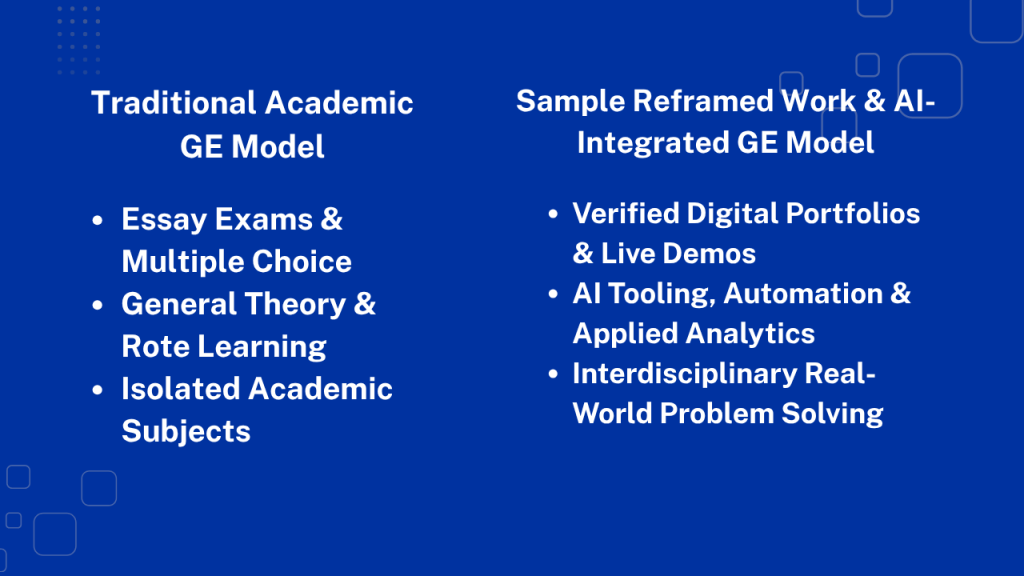
Simply cutting GE units to 18 risks turning higher education into narrow vocational training. The solution lies not in eliminating subjects, but in elevating and reframing them into work-focused, futuristic learning experiences.
Instead of repeating basic high school drills, tertiary GE should build economic literacy, AI fluency, and strategic career navigation—giving graduates the tools to make informed life and career choices based on data.
5. A Comparative Blueprint: Senior High Redundancy vs. Futuristic GE
To eliminate content overlaps between Senior High School (SHS) and college, tertiary General Education must shift toward high-value, practical outputs.
A public Client Pitch Deck, Freelance Proposal, or Corporate Communication Suite
Mathematics in the Modern World(Stats and formulas)
Data Analytics & Financial Intelligence
Financial modeling, inflation impact assessment, market trend analysis, and data visualization
A dynamic Business Analytics Dashboard or Personal Financial Strategy Model
Science, Technology, and Society(General science history)
AI Automation & Emerging Tech Ethics
Prompt engineering, workflow automation, low-code development, and ethical AI auditing
An automated AI Workflow Integration or Tech Impact Audit Report
Understanding the Self(Self philosopy/psychology intro)
Career Strategy & Personal Branding
Labor market analysis, personal positioning, remote-work readiness, and portfolio architecture
A live GitHub/Behance Portfolio, LinkedIn Strategy, and Professional Digital Resume
Art Appreciation(Static art history)
UI/UX Design & Visual Communication
Visual branding, user interface design, visual storytelling, and digital content creation
A complete UI/UX App Prototype or Brand Identity Media Kit
6. The Philippine Opportunity: From “Graduate-Ready” to “Work-Ready”
The Philippines has already reduced the number of college GE units from the pre-K to 12 framework.
The next question should therefore be less about simply reducing or increasing the number of GE subjects.
It should be about what students can actually do after completing them.
The evidence points toward a potential direction:
Keep the foundations.
Reduce unnecessary duplication.
Increase practical application.
Strengthen digital and AI literacy.
Connect education with industry.
Build portfolios.
Expand experiential learning.
Update curricula more frequently.
For example, professional communication is a transferable skill that can be strengthened through recognized English proficiency assessments. CEFR-aligned proficiency levels and TOEIC assessments could serve as optional ways for students to demonstrate their English-language abilities, complementing GE coursework and portfolio projects. Education and training providers such as Hopkins.ph could be explored as potential partners for language-learning and assessment pathways, subject to verification of their specific offerings and certification arrangements.
This is especially important because EDCOM II reported that CHED’s review and updating of bachelor’s-degree Policies, Standards and Guidelines has historically taken an average of about 11 years, raising concerns about keeping curricula aligned with rapidly changing workforce and technological needs.
A curriculum that takes more than a decade to substantially update can struggle to respond to technologies that may transform within only a few years.
7. Empowering Graduates as Strategic Decision-Makers for 2030
General Education in the Philippines’ Future
General Education should not become a collection of employment-training subjects.
History still matters.
Ethics still matters.
Art still matters.
Communication still matters.
Mathematics still matters.
Science and technology still matter.
Understanding society still matters.
But their value can become greater when students are taught how to apply these forms of knowledge to real problems.
The future of Filipino education may therefore require a shift from:
“What subjects should students complete?”
to:
“What should Filipino graduates be able to understand, create, solve, communicate and demonstrate by the time they enter the workforce?”
A reframed General Education curriculum could answer that question by combining human knowledge, professional skills, digital literacy, AI awareness, entrepreneurship and practical experience.
The ultimate goal should not be to produce graduates who are trained only for today’s jobs.
It should be to produce Filipinos who are capable of learning, adapting and creating value in the jobs of tomorrow.
By 2030, the most valuable graduate may not simply be the one with the longest list of completed subjects.
It may be the graduate who can say:
“Here is what I learned. Here is what I can do. Here is what I created. Here is how I solved a problem. And here is how I can continue learning when the world of work changes.”
References:
laferenal. (2026). Princeton assessments and Training, Inc. TOEIC, TOEFL – Princeton Assessments and Training INC.
Philippine Statistics Authority. (2023, July 10). Family Income and Expenditure Survey | Philippine Statistics Authority | Republic of the Philippines. Psa.Gov.Ph.